Self-Soothing Strategies
Self-soothing, self-regulation, emotional regulation… by any name, the goal is to give you tools to get you through the difficult moments when you might not have access to professional or personal support. What do you do in those times that aren’t about doing deep work, but rather calming your nervous system and giving yourself enough support to make it to a better, lighter moment?
Here are some strategies that can help you to feel safer in your body and more in control of your thoughts and feelings.

Note: You are the expert on what you need, and on what makes you feel better. If you try an exercise and find it’s making you feel worse, stop and try something else - it can take time to find the right one(s) for you.

Grounding Exercises
These are aimed at helping you use your senses to orient yourself to your current surroundings, which helps your nervous system learn that you are safe. Give these a try…Room Scan: Sit or lay down comfortably. Turn your head slowly toward one side of the room you are in. Pick an object - describe its appearance, its texture, what it might feel like to touch it. As you slowly turn your head toward the other side of the room, see how many things you can find that are the same colour as that first object. Every time you find an object of the same colour, take a moment to describe its physical attributes in detail. Keep going until your gaze has reached the other side of the room. Do it again with a different colour if you like!
Breath work: There are so many great techniques for this. Consistent breathing is key - try starting with a pattern of inhaling through your nose for five seconds, then exhaling through your mouth for five seconds. Try experimenting with extending the length of the exhale.
Meditation: Mindfulness meditation can be a great way to calm the nervous system. Insight Timer has some great guided meditations, some as short as one minute. So does Tara Brach (hers are on the longer side) - her RAIN meditation can be a great resource for moving through troubling emotions. (Remember, as always, do what feels good! If meditation is feeling too intense at the moment, skip it and try something else.)
Click here to access a free resource from the University Health Network with other grounding options to try.

Sensory Comfort
Take a moment to notice what would feel good for your body right now. Is it a soft blanket? A warm beverage? A snack? A cool shower? Try to offer yourself something that will make your body feel even just five percent more comfortable.
Sometimes, what our bodies will tell us they need is movement. If this is the case for you, practice movements you can do safely - walking, running, rolling around on the ground, doing jumping jacks - anything at all, so long as it’s safe and feels good to you.

Working With Your Emotions
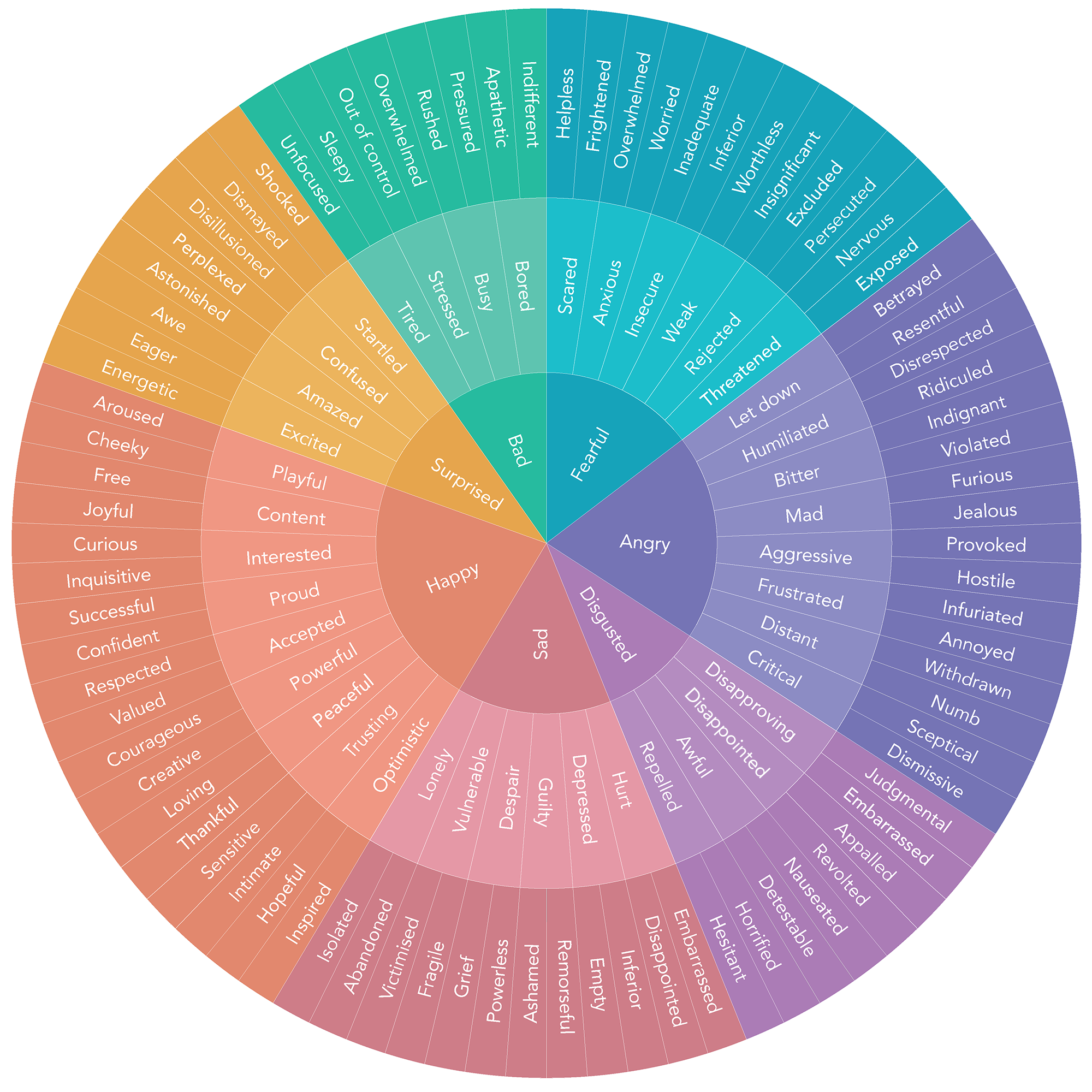
When an emotion is overwhelming you, it can feel all-encompassing. Sometimes we can remind our nervous systems that an emotion is a temporary thing - and not a life-or-death situation - by naming the emotion and starting to think of it as something separate from ourselves.
The feelings wheel, below, can be a good place to start (and you can click on it for a bigger version) - without thinking too hard about it, see if you can find one or two words on the wheel that describe the emotion you’re feeling now.
If it feels tolerable to do so, take a moment to quietly turn inward and notice qualities of the emotion you’re feeling. What is the physical sensation it’s producing in your body? If the emotion had a physical colour or shape, what would it be? Is there an image that goes with the emotion? This practice can help you to gain some distance from the emotion that’s feeling intense right now.
If the emotion is still intense, try practicing containment strategies. Rather than trying to make the emotion go away, we can imagine that we’re putting it in a box, and that we’ll open it up when we have more capacity - this could be in therapy, when talking with a friend, etc. Click here for more information about emotional containment strategies.

Comfort Media
For many of us, engaging with media that we like - tv shows, movies, books, games - can be an important outlet. The power of media can be harnessed to use as a tool when you’re feeling dysregulated, too.
Take a moment to think about what would feel the most comforting for you. Does your nervous system need the escape and novelty of something you haven’t read / watched / played before, or would the familiar world of one of your favourite shows, games, or books provide needed comfort?
A “timer technique” can be useful here - this could look like telling yourself, “I’ll watch my favourite show for ten minutes, and if I’m not feeling any better by then, I’ll call someone / go for a walk / do one of the other things on this list.” If you are feeling better, great! Feel free to keep watching, and remember that distracting yourself in this way is totally fine - this moment isn’t about doing the deep work, but about holding you over until you have more capacity.

Togetherness
Although our focus is on self-soothing, it is important to mention that when the option is available to us, being with another person can be a powerful regulating tool.
Connection can be face-to-face, over the phone, or virtual (e.g. over text message). You might find it helpful to share with a friend or family member about what you’re feeling, or may find it comforting just to be in their presence - there’s no pressure for you to share anything that feels difficult to share. The focus is on helping you to feel grounded, supported, and regulated.
Sometimes, it can feel helpful to be around other people in a public place like a cafe or library. If you choose to do this, make sure you’re going somewhere safe.
If you’re feeling like you may be in crisis and need immediate mental health support, including if you’re having thoughts around self-harm, it’s a good idea to call a 24-hour crisis line like the Gerstein Crisis Centre at 416-929-5200. If you prefer texting, you can also text 988 from anywhere in Canada for support.
An Important Note:
If you are feeling suicidal, it’s important to get help right away. Please consider using one of the options below:
Call the Gerstein Crisis Centre at 416-929-5200 for 24/7 support
Call or text 988 from anywhere in Canada to receive support around suicidality, 24/7
Visit your local emergency room